Purchasing a new phone package can get pretty pricey, especially if you’re working for a small to medium-sized business. Of course, when shopping for the right phones, service and dial tone providers, you’ll want to consider the overall total cost of ownership (TCO) to ensure that you’re getting the best bang for your buck. But, even if you do walk away with a really great price on the total package, it can be hard to find the financial resources right upfront for all of the services your company needs.
At Maverick Networks, Inc., we understand all too well. In fact, we fall under the SMB category, as well. That’s why we’ve partnered with Great America Leasing to provide our customers and clients with the best services and products they can get without having to empty out their pockets.
Purchasing a new phone package can get pretty pricey, especially if you’re working for a small to medium-sized business. Of course, when shopping for the right phones, service and dial tone providers, you’ll want to consider the overall total cost of ownership (TCO) to ensure that you’re getting the best bang for your buck. But, even if you do walk away with a really great price on the total package, it can be hard to find the financial resources right upfront for all of the services your company needs.
At Maverick Networks, Inc., we understand all too well. In fact, we fall under the SMB category, as well. That’s why we’ve partnered with Great America Leasing to provide our customers and clients with the best services and products they can get without having to empty out their pockets.
Showing posts with label Maverick Networks. Show all posts
Monday, March 19, 2012
Thursday, March 1, 2012
Customer Profile: Fast moving company needed a solution... Fast!
Zettaset, provider of a Hadoop-based data platform for storing and analyzing large data sets, had a lot going on.
They were moving to a new office, hiring people at a quickening pace, and about to launch their first public marketing campaign.
“We realized that the phone was going to start ringing, but we didn’t have a plan for dealing with that,” said Tim Reilly, Zettaset Controller.
“I was familiar with Maverick Networks, and knew they had done a great job for some colleagues of mine. We didn’t have time or the ‘bandwidth’ to go through a lengthy process and review a lot of options, so I just called on Maverick to step in and take care of it,” he said.
Enter Maverick Networks.
“Given their plans to tie a couple of U.S. offices together, expected growth in the European market, and desired features, the Small Enterprise Package from ShoreTel was a good fit,” Lee said.
“As the VP of Finance and Operations, I am especially impressed by the Compass Solution Maverick put together. Instead of buying the system as a capital expensive, we pay a single, low monthly payment to cover use, upgrades and maintenance of the system. This was the right move for our young company,” Reilly said.
Within a matter of two weeks, Maverick Networks coordinated installation of cabling, provisioning of Internet connectivity, installation and configuration of the equipment, and use training.
Wednesday, February 22, 2012
Mobile security - it doesn't have to be a Wild West standoff
Last month, we posted a blog about the “bring your own device” (BYOD) practice that more and more businesses are welcoming as a part of their internal communications.
While we could speak all day on the plethora of benefits this provides for organizations, there’s another trend running parallel to this that IT directors should be wary of, and it’s not a good one.
| "This network ain't big enough for the two of us!" |
Think of the recurring use of personal devices for work purposes like the old, Wild West. There are many landscapes still being discovered while more and more people join the trend. But, like the Wild West, there’s still a lack of governance for these new landscapes. Therefore, there are more possibilities for some “bad apples” to take over the territories for themselves, putting peoples’ smart phones and tablets in jeopardy.
| Nope. He's not living among the Kiwis. |
Confused by the Wild West reference? We’re talking about hackers here, people.
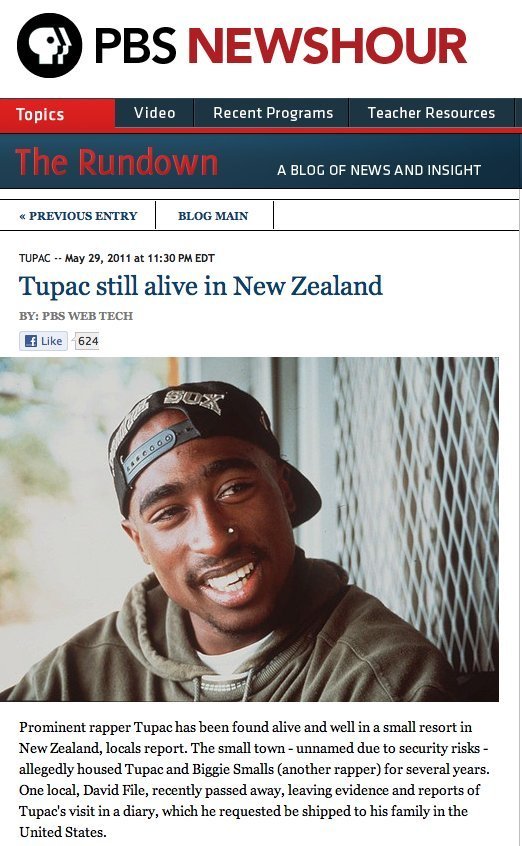
Hackers, like the people that have enough technical experience that they can take control of others' computers from their own device, no matter the distance between the two operating systems, or can sneak in to PBS’s network and tell the world that former rap star Tupac Shakur was still alive and living in New Zealand (*cough* LulzSec *cough*).
In February 2011, PC World reported than cybercrime had doubled in growth "year after year," and according to Noa Bar-Yosef, senior security strategist for Imperva, "In the last half of (2010) there were 2,383 mobility-related keywords in hacker forum threads compared to only 264 on the previous half - almost a tenfold increase" (Keeping Data Safe When it Leaves the Corporate Nest).
These hackers are using the same tactics with mobile devices as they have for years with computers - installing malware, phishing, etc. The difference now, however, is that companies, particularly those with sensitive data, that allow their employees to use their own devices for out-of-office communication, are at a much higher risk of a security breach on their data and information than they were before.
Why is this the case? Because there is still limited IT control over these devices. A personal device is thought to be just that, personal. But when an employee makes the decision to bring it to work and use it for business-related transactions and communication, their phone is no longer just their own device.
"Organizations need to respond to this trend by developing policies to address new mobile work styles that can drive productivity through more flexible working, while safeguarding the use of data and sensitive information," wrote Stephen Withers in an article for iTwire last November.
- Remote wipe and lock: IT managers can required employees to install remote wiping software on their device before using it for work. This allows IT to lock down and erase data if the device is stolen or lost.
- GPS tracking: "Some Mobile Device Management (MDM) solutions allow IT to send an alarm to the device to help identify the location for a user, and if truly lost, IT can then leverage the wipe and lock technology mentioned above."
- Network authentication, authorization, account: IT can adopt a solutions that tie devices connected with the organization's network with each user's identity and role, then apply proper policies (depending on the role) to grant certain access privledges. "This enables IT to differentiate access for different levels of employees or guests, or even by device type. It also lets IT take a proactive stance on tracking and monitoring how mobile devices are being used within their network."
- Secure remote support: Many users of BYOD use person mobile devices for work when out of the office - having a secure way to support and fix these devices from a remote location is necessary. It allows help desks to "configure devices, chat, transfer files, and even remotely see and control the device."
- Acceptable use policy: As a company would expect its employees to use their computers only for work-appropriate purposes, so should it expect its employees to use their personal devices if they choose to use them for work. Having employees sign an Acceptable Use Agreement to allow them access to the company network with their person device allows IT to have a better grasp on the conditions under which the employee is allowed to use their phone. The agreement may include conditions, such as installing a device certificate or the remote wipe software, or state that devices can be seized if necessary for legal matters.
While some may see IT taking such measures as a bit controlling, at the end of the day, it will ensure security, not just for the company's data, but also for the person to whom the device belongs and their personal data (i.e. banking information, personal account logins, contact information, etc.). And, just like in the old, Wild West, when a new sheriff comes in to town (or, in this case, a new IT policy regarding personal devices), keeping order is a shared responsibility between both parties. The "sheriff" lays down "laws" to ensure everyone's safety, and if people follow these laws, they're less likely to be harmed by malicious, external forces.
Labels:
cell phone,
company policy,
computers,
IT director,
IT managers,
Maverick Networks,
Mitel,
mobility,
security,
smart phone,
tablet,
virus,
Wild West
Wednesday, February 1, 2012
Total Cost of Ownership - What are you REALLY paying for?
Purchasing a new phone system is like buying a new car. If you’re in the market for a new automobile, you’re not going to fork over money for the first piece of metal on wheels that you see. Chances are, you’ve researched the kind of car you want – the year, the make, the model, the engine power, etc. Then, when thinking about how much you’re going to spend on the car, you don’t think of how much just the car itself will cost. Other factors come in to play financially – the interior of the car (do you want leather or cloth?), the built-in amenities (do you want a car that’s OnStar-ready, or one with hands-free, Bluetooth capabilities?), the type of tires the car needs, the oil that goes in it, the type of gas it needs (regular, premium, or diesel?), and, most importantly, how much car insurance will cost with your new purchase.
If you’re an IT director at a company in need of a new phone system, you’re probably shopping for handsets and network providers in the same way. You’re going to look at different vendors and providers that match your company’s needs to the products available from these suppliers. You’ll look at the pricing of the products and services and compare them to what your company’s budget can afford. But one of the main things you should be wary of when shopping for a new phone system is the total cost of ownership (TCO), especially with an economy that’s seen brighter days.
Considering the financial landscape of the last four years, IT spending may not be at the forefront of many CIOs’ agendas. However, according to an article on CIO.com, a survey conducted by CDW IT Monitor revealed that there is an uptick in economic confidence with increasing IT budgets.
Last month, ShoreTel revealed results from a comprehensive industry study from Aberdeen Group that showed ShoreTel Unified Communications solution as having the lowest TCO in the telecommunications industry.
The survey also revealed that ShoreTel IP phone deployment took only 53 minutes to complete as compared to Avaya Aura, which took more than 2.5 hours for each phone, and the cost for recurring training for a ShoreTel system was 85 percent less than the recurring training cost for an Avaya IP Office system.
At Maverick Networks, Inc., we partner with companies like ShoreTel to ensure that our customers and clients are getting the most for their money. We offer the best products at competitive prices because we know that it’s the quality of the products and services that matter the most in the long-term when it comes to IT spending.
For more information on what we offer, or to get a quote for your company’s UC needs, visit our website or contact us at info@mavericknetworks.net
If you’re an IT director at a company in need of a new phone system, you’re probably shopping for handsets and network providers in the same way. You’re going to look at different vendors and providers that match your company’s needs to the products available from these suppliers. You’ll look at the pricing of the products and services and compare them to what your company’s budget can afford. But one of the main things you should be wary of when shopping for a new phone system is the total cost of ownership (TCO), especially with an economy that’s seen brighter days.
Considering the financial landscape of the last four years, IT spending may not be at the forefront of many CIOs’ agendas. However, according to an article on CIO.com, a survey conducted by CDW IT Monitor revealed that there is an uptick in economic confidence with increasing IT budgets.
“CIOs are looking at every IT investment in terms of how it makes sense for the business and our data shows they are still spending on key investments including software and hardware – particularly mobile devices, virtualization and security... The investments that are being planned by CIOs for late this year reflect a decided shift to software installations – at a level that CDW calls the greatest on record, and covering a significant part of their organizations.”With the shift of budget focus to software installations that allow for mobility, virtualization and security, analyzing the overall TCO of a purchase from a vendor is incredibly important.
Last month, ShoreTel revealed results from a comprehensive industry study from Aberdeen Group that showed ShoreTel Unified Communications solution as having the lowest TCO in the telecommunications industry.
"The survey of 236 different businesses validates that ShoreTel’s unified communications solution is the easiest to use, deploy and manage when compared to other solutions in the market today…When considering a phone system, measuring the TCO requires planning for the future. Important things to consider outside of the hardware itself are installation and implementation (ensuring proper cabling and a service provider that is compatible with your phone system), maintenance costs (in a perfect world, the only time an organization would need a new phone system would be for an upgrade to keep “with the times”… but it’s not a perfect world, and things break, wear out, and stop working), additional application add-ons and their compatibility with the phone system (like we’ve mentioned before, mobility and BYOD are increasingly being adopted by businesses to expand their efficiency and cut costs), training (let’s face it – new technology, especially conference-capable technology, can be confusing and hard to learn on your own), and licensing.
ShoreTel’s UC solution was designed from the ground up to take advantage of IP technology – making it better suited to the realities of business than other ‘IP-enabled’ legacy technology or bolted-together systems, which are inherently complex… Enterprises can scale with ease by simply plugging in an addition switch – without the need to rip and replace infrastructure. Moves, adds and changes (MACs) can easily be performed in-house because of the ability to manage users instead of devices, reducing the time, complexity and cost of system administration. These fundamental differences are what enable ShoreTel to provide the lowest total cost of ownership in the industry.”
![]() |
| Upfront training cost for new Deployments from Aberdeen study. |
The survey also revealed that ShoreTel IP phone deployment took only 53 minutes to complete as compared to Avaya Aura, which took more than 2.5 hours for each phone, and the cost for recurring training for a ShoreTel system was 85 percent less than the recurring training cost for an Avaya IP Office system.
At Maverick Networks, Inc., we partner with companies like ShoreTel to ensure that our customers and clients are getting the most for their money. We offer the best products at competitive prices because we know that it’s the quality of the products and services that matter the most in the long-term when it comes to IT spending.
For more information on what we offer, or to get a quote for your company’s UC needs, visit our website or contact us at info@mavericknetworks.net
Thursday, January 12, 2012
Geeking out over VoIP-enabled toys
If you work in the telcommunications industry, you’re probably a tech geek of some sort. You might not consider yourself one if you’ve just joined the industry, but if you stick around long enough to learn about the technology available and can successfully sell telecom products simply based on the passion you exude for what you’re selling (call recording and mobility applications, anyone?), chances are somebody, somewhere, will think of you as a geek.At Maverick Networks, we definitely have our geeky moments. For instance, our marketing and PR specialist, Jennifer Leslie (@JennMariePR), shed a few tears this week because she wasn’t at the 2012 International CES tradeshow. Fortunately for her, her obsession with social media allowed her to get constant updates via Twitter from accounts such as Pete Cashmore of Mashable,
CNET and TechCrunch.
So, when she stumbled upon an article by Adam Bunker of Electricpig about some of the weirdest gadgets at CES 2012, we couldn’t contain our geeky excitement over the VoIP LEGO, a version of the LEGO Mindstorms NXT line. According to the article, the vehicle/robot can be controlled via Skype, enabling users to “call” it and control it from anywhere in the world.
What we can’t decide is what’s more intriguing about this production – the fact that VoIP technology can be used to control a LEGO robot, or the fact that the creator of the project is only 14-years-old! For the sake of our blog’s content, we’ll speak on the technology rather than his age (but really… 14-years-old and making headlines at CES with his knowledge of web code, screen sharing, and Bluetooth connectivity. We sure are impressed!)
Leon, the pre-teen mastermind behind this creation, explains how the robot works on his blog, World of MindStorms:
“The webpage is fairly simple – it’s got three arrows (one forward, two to the sides) and a start and a stop button. Clicking the start arrow will begin a Skype conversation with my computer, after which the user should share their screen; the NXT standing in front of my computer (called 'Jeeves') can then “see” the webpage the user is viewing.
That’s where the cool part kicks in – when the user clicks any one of the arrows or the stop button, the page will change to a different shade of gray. This shade of gray is then picked up by Jeeves, who turns it into a Bluetooth message for the other NXT (called 'Alfred'). The car then drives in the direction the user tells it to, while remaining within a fenced off area where the webcam can see it.
So, the user can drive a LEGO Mindstorms NXT car, from the comfort of his or her home, without having to install any kind of software (provided that they have Skype).”
You can also watch the robot in action on his blog, as well.
Although the idea is fairly simple and there is only one robot able to be controlled, this kid’s ease with such a common video conferencing source likeSkype shows that advances in telecom technology is moving faster than ever, and reaching younger and younger audiences.
We’d like to think of Leon as a maverick, as well. By thinking outside the [LEGO] box, he's found a way to use such a common tool and turn it in to something that may actually be of use one day for many businesses. Sure, the U.S. government has far more advanced technologies to control devices like a drone, but who knows what use companies will find for VoIP-controlled devices modeled after Leon’s LEGO Mindstorms NXT car?
All we can say is geek on, little man, and keep up the hard work so that we may be able to sell your technology one day.
Labels:
CES,
geek,
Maverick,
Maverick Networks,
robot,
Skype,
teleccom,
Telecommunications,
VoIP
Tuesday, January 10, 2012
"Resolving" business communications
It’s the beginning of a new year, which means it’s time to work on those New Years resolutions. Maverick Networks might be able to help.
While we can’t promise to help you to lose weight or trim off bad habits, we can help your business become more efficient, save money, retain employees (even those at a distance) and decrease its carbon footprint by employing unified communications within your company.
Need a better understanding of what unified communications means? We can help with that, too.
Unified communications (UC) is the convergence of real-time communications services (such as instant messaging, video conferencing, data sharing, etc.) with non-real-time communication services (such as e-mail, SMS and fax). It allows users to send a message from one medium and receive the same message through another medium over Internet protocol (IP), often at a much faster speed than through the public switched telephone networks traditionally used.
For example, Jack leaves a voicemail for Jill. Jill, however, is in an important business meeting and cannot pick up her phone to listen to the voicemail. Instead, Jill can open her e-mail from her smartphone or tablet and be able to read the message that Jack has left. If Jill wants to respond, she can write her response via e-mail to Jack, who can receive the message through his e-mail inbox, or listen to it from his voicemail.
Sounds pretty cool and technological, right? We think so, which is why we’re so passionate about what we sell.
We know that when a company employs UC within their workplace, their work efficiency increases. People no longer have to wait around for important responses, which can delay progress, and employees can all be better connected around the clock.
While our country is slowly but surely climbing out of a recession, cutting costs is still crucial to keep a company afloat. But, instead of having to decrease workforce because of lack of space or lack of resources, businesses can use converged communication technology to keep employees even more in touch than ever, even if they’re working from home or out of other, more distant offices.
Another perk of utilizing UC? Travel time and commuting expenses are cut, which not only helps businesses to save time and money, it also contributes to keeping their CO2 emissions down. Services like video conferencing over IP can allow Jack, who is located in Portland, to meet with Jill, who is located in Los Angeles, without having to leave the office.
Through mobility-enabled UC services, users can have phone calls seamlessly rerouted from their office phone to their own mobile device, for any important calls that may come in while that person is in the field or in transit. Users can even make calls from their mobile device under their office number (known as single number reachability), so their personal number doesn’t have to be revealed (or, even cooler, the person on the other end of the line doesn’t have to know that the user isn’t at his or her desk).
So, even if you end up dropping your personal New Years resolutions by Valentine’s Day, through unified communications, you can ensure that your business’s “resolutions” can remain fulfilled for years to come.
While we can’t promise to help you to lose weight or trim off bad habits, we can help your business become more efficient, save money, retain employees (even those at a distance) and decrease its carbon footprint by employing unified communications within your company.
Need a better understanding of what unified communications means? We can help with that, too.
Unified communications (UC) is the convergence of real-time communications services (such as instant messaging, video conferencing, data sharing, etc.) with non-real-time communication services (such as e-mail, SMS and fax). It allows users to send a message from one medium and receive the same message through another medium over Internet protocol (IP), often at a much faster speed than through the public switched telephone networks traditionally used.
For example, Jack leaves a voicemail for Jill. Jill, however, is in an important business meeting and cannot pick up her phone to listen to the voicemail. Instead, Jill can open her e-mail from her smartphone or tablet and be able to read the message that Jack has left. If Jill wants to respond, she can write her response via e-mail to Jack, who can receive the message through his e-mail inbox, or listen to it from his voicemail.
Sounds pretty cool and technological, right? We think so, which is why we’re so passionate about what we sell.
We know that when a company employs UC within their workplace, their work efficiency increases. People no longer have to wait around for important responses, which can delay progress, and employees can all be better connected around the clock.
While our country is slowly but surely climbing out of a recession, cutting costs is still crucial to keep a company afloat. But, instead of having to decrease workforce because of lack of space or lack of resources, businesses can use converged communication technology to keep employees even more in touch than ever, even if they’re working from home or out of other, more distant offices.
Another perk of utilizing UC? Travel time and commuting expenses are cut, which not only helps businesses to save time and money, it also contributes to keeping their CO2 emissions down. Services like video conferencing over IP can allow Jack, who is located in Portland, to meet with Jill, who is located in Los Angeles, without having to leave the office.
Through mobility-enabled UC services, users can have phone calls seamlessly rerouted from their office phone to their own mobile device, for any important calls that may come in while that person is in the field or in transit. Users can even make calls from their mobile device under their office number (known as single number reachability), so their personal number doesn’t have to be revealed (or, even cooler, the person on the other end of the line doesn’t have to know that the user isn’t at his or her desk).
So, even if you end up dropping your personal New Years resolutions by Valentine’s Day, through unified communications, you can ensure that your business’s “resolutions” can remain fulfilled for years to come.
Tuesday, January 3, 2012
A little about Maverick Networks...
A little about Maverick Networks, Inc. for our first blog:As you probably have guessed, we are not Tom Cruise, nor are we in any way affiliated with him or the blockbuster classic, "Top Gun." However, our company shares something in common with the 1986 film, which is that we are all mavericks.
The story goes like this: Maverick Networks CEO, Aaron Lee, was considered a “Top Gun” (i.e. – a successful sales rep) at his previous telecommunications employer, but left the company in October of 2003 to start his own telecom company from the ground up. Lee decided to use the name Maverick because it gave a sense and persona of what our company truly is in its industry – one that stands out from the crowd. It’s a cultural symbol and name that we stand behind and believe in every day.
We have always taken the stance of being different than what our competitors do for their prospects and customers. It's what has allowed us to achieve the awards we have received over the last few years (Fastest Growth in SF Bay Area List, INC 5000 in 2009, to name a few). Our beginning was like many startups, working out of the home office. Shortly after launching, we moved into a small warehouse space at a friend’s office in Hayward, Calif., and finally into a real corporate office space in our current location in Pleasanton, Calif.
It’s been a fun ride along the way as our customer base has grown with Pure VoIP Telephony solutions, and as we have established our distinct flair for being trusted advisors for voice solutions.
Our logo was created by combining a maverick mentality (horns) and networks (rings) circling a sphere (our home, Planet Earth).
Our goal began, and continues to be, extreme customer focus and satisfaction. We do this by providing innovative ideas and solutions to companies looking for voice convergence solutions. So, if your company is looking for a VoIP Converged Solution and have a need for a Top Gun or Maverick look no further and contact us for a free consultation.
Labels:
Convergence,
Maverick,
Maverick Networks,
Telecommunications,
VoIP
Subscribe to:
Posts (Atom)